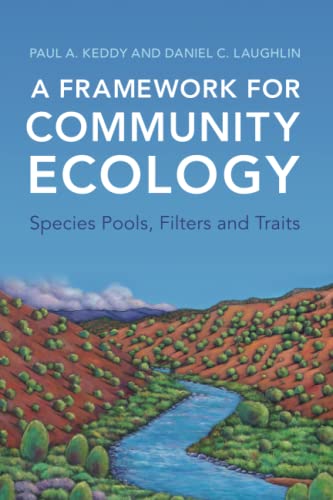
A framework for community ecology : species pools, filters and traits Paul A. Keddy and Daniel C. Laughlin
Tipo de material: Libro
impreso(a)
Idioma: Español Detalles de publicación: Cambridge, United Kingdom Cambridge University Press c2022Descripción: xi, 360 páginas fotografías, gráficas, ilustraciones, mapas 23 cmTipo de contenido:
Libro
impreso(a)
Idioma: Español Detalles de publicación: Cambridge, United Kingdom Cambridge University Press c2022Descripción: xi, 360 páginas fotografías, gráficas, ilustraciones, mapas 23 cmTipo de contenido: - texto
- sin medio
- volumen
- 9781009068314
- 333.9516 K9
| Tipo de ítem | Biblioteca actual | Colección | Signatura topográfica | Estado | Código de barras | |
|---|---|---|---|---|---|---|
| Libros | Biblioteca Chetumal Acervo General (AG) | Acervo General | 333.9516 K9 | Disponible | ECO030009091 |
Bibliografía: páginas 320-349
Preface.. 1 A General Framework for Community Ecology.. 2 Filters.. 3 Species Pools.. 4 Traits.. 5 Trait–Environment Interactions.. 6 Functional Groups.. 7 Predictive Models of Community Assembly.. 8 Prospects and Possibilities.. References.. Index
This book addresses an important problem in ecology: how are communities assembled from species pools? This pressing question underlies a broad array of practical problems in ecology and environmental science, including restoration of damaged landscapes, management of protected areas, and protection of threatened species. This book presents a simple logical structure for ecological assembly and addresses key areas including species pools, traits, environmental filters, and functional groups. It demonstrates the use of two predictive models (CATS and Traitspace) and consists of many wide-ranging examples including plants in deserts, wetlands, and forests, and communities of fish, amphibians, birds, mammals, and fungi. Global in scope, this volume ranges from the arid lands of North Africa, to forests in the Himalayas, to Amazonian floodplains. There is a strong focus on applications, particularly the twin challenges of conserving biodiversity and understanding community responses to climate change. Inglés