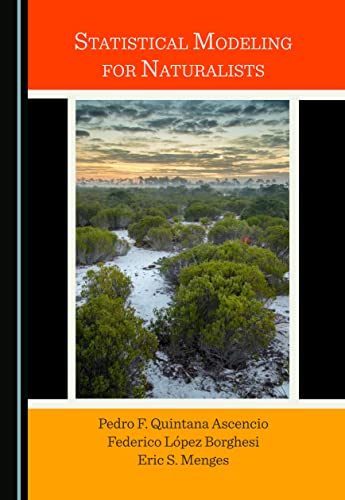
Statistical modeling for naturalists by Pedro F. Quintana Ascencio, Federico López Borghesi and Eric S. Menges
Tipo de material: Libro
impreso(a)
Idioma: Inglés Detalles de publicación: Newcastle upon Tyne, Reino Unido Cambridge Scholars Publishing 2022Descripción: xi, 199 páginas gráficas, ilustraciones 21 cmTipo de contenido:
Libro
impreso(a)
Idioma: Inglés Detalles de publicación: Newcastle upon Tyne, Reino Unido Cambridge Scholars Publishing 2022Descripción: xi, 199 páginas gráficas, ilustraciones 21 cmTipo de contenido: - texto
- sin medio
- volumen
- 1527589501
- 9781527589506
- 508.0727 Q8
| Tipo de ítem | Biblioteca actual | Colección | Signatura topográfica | Estado | Código de barras | |
|---|---|---|---|---|---|---|
| Libros | Biblioteca Campeche Acervo General (AG) | Acervo General | 508.0727 Q8 | Disponible | ECO040007343 |
Incluye bibliografía: páginas 190-197 e índice: páginas 198-199
Acknowledgements.. Foreword.. Preface.. Chapter I Models in Ecology.. Chapter II Florida Scrub.. Chapter III Connecting Models with Data: A Quick Glance at Probability.. Chapter IV Bayesian Approaches: The Average Height of a Rare Plant.. Chapter V The Importance of Assumptions: Evaluating Reproductive Outputs.. Chapter VI The Use of Priors: Plant Height and Number of Tillers in Wire Grass.. Chapter VII Analyzing Binary Responses: Trade-offs between Reproduction and Survival.. Chapter VIII Random Effects of Populations: Revisiting Reproductive Outputs.. Chapter IX Count Data: Seeds per Fruit.. Chapter X Data with too Many Zeros: Rcproductive Biology.. Chapter XI Model Selection for Mixcd Models: Effects of Size, Reproduction, and Time-sincc-Iire on Survival.. Chapter XII Spatial and Temporal Variation: Effects of Fire and Habitat Structure on Reproduction.. Chapter XIII Integration: Population Dynamics in Natural and Humanized Environments.. Chapter XIV Modeling Humanized Environments.. Bibliography.. Index
This book will allow naturalists, nature stewards, and graduate students to appreciate and comprehend basic statistical concepts as a bridge to more complex themes relevant to their daily work. Although there are excellent sources on more specialized analytical topics relevant to naturalists, this introductory book makes a connection with the experience and needs of field practitioners. It uses aspects of the natural history of the Florida scrub relevant for conservation and management as examples of analytical issues pertinent to the naturalist in a broader context. Each chapter identifies important ecological questions and then provides approaches to evaluate data, focusing on the analytical decision-making process. The book guides the reader on frequently overlooked aspects such as the understanding of model assumptions, alternative model specifications, model output interpretation, and model limitations. Inglés