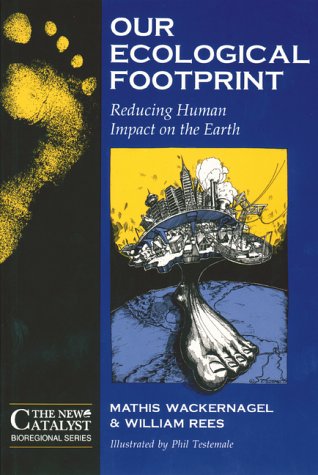
Our ecological footprint : reducing human impact o the earth Mathis Wackernagel, William E. Rees
Tipo de material: Libro
impreso(a)
Idioma: Inglés Series Detalles de publicación: Gabriola Island, British Columbia, Canada Mathis Wackernagel and William E. Rees New Society Publishers 1996Descripción: xi, 160 páginas ilustraciones, mapas, retratos 23 centímetrosTipo de contenido:
Libro
impreso(a)
Idioma: Inglés Series Detalles de publicación: Gabriola Island, British Columbia, Canada Mathis Wackernagel and William E. Rees New Society Publishers 1996Descripción: xi, 160 páginas ilustraciones, mapas, retratos 23 centímetrosTipo de contenido: - Texto
- Sin medio
- Volumen
- 1550922513
- 9781550922516
- 086571312X
- 9780865713123
- 338.9 W3
| Tipo de ítem | Biblioteca actual | Colección | Signatura topográfica | Estado | Código de barras | |
|---|---|---|---|---|---|---|
| Libros | Biblioteca San Cristóbal Acervo General (AG) | Acervo General | 338.9 W3 | Disponible | ECO010020242 |
Glosario: páginas 158-160
Acknowledgments.. Preface.. Introduction.. Why Worry About Sustainability?.. What We Hope to Achieve.. A Matter of Perspective.. 1. Ecological Footprints For Beginners.. Obvious but Profound: We Depend on Nature.. What is an Ecological Footprint?.. So What? The Global Context.. Dr. Footnote Explains.. The Power of Science.. The Wisdom of the Marketplace.. The Doctrine of Free Trade.. The Uncertain Future.. The Technological Fix.. The Mantra of Optimism.. The Growth of Limits.. Planning for a Sustainable Future.. 2. Footprints and Sustainability.. The Sustainability Debate: A Simple Concept Leads to Conflicting Strategies.. The sustainability challenge.. Strong sustainability: the ecological bottom-line condition for sustainability.. The Brundtland Commission's proposed response.. The Ecological Footprint: A Tool for Planning Toward Sustainability.. Measuring progress toward sustainability: the dos and don'ts.. Learning from ecology: revisiting human carrying capacity.. Turning carrying capacity on its head: human Ecological Footprints.. How Ecological Footprint analyses can help advance sustainability.. 3. Fun With Footprints: Methods & Real-World Applications.. Making the Ecological Footprint Idea Work.. Calculation Procedure.. Consumption categories.. Land and land-use categories.. The consumption-land-use matrix.. The Footprint in Action: Adapting the Calculation Procedure to Specific Applications.. 1) How big is the Ecological Footprint of the average North American?.. 2) How large is the Vancouver regional Footprint?.. 3) A global comparison of Footprint sizes — could everybody on Earth today enjoy North Americans' current ecological standard of living?.. 4) Footprinting Great Britain.. 5) European examples: The Ecological Footprints of the Netherlands and the Trier Region of Germany.. 6) A Regional Analysis from Australia.. 7) What does ecological dependence mean for trade?.. 8) Is a person's Ecological Footprint related to income?.. 9) Housing choice affects our Footprints.. 10) How much ecologically productive land supports commuting by bicycle, bus and car?.. 11) Did you know that tomatoes leave Footprints?.. 12) The Ecological Footprint of bridges.. 13) Learning about sustainability in schools and in the outdoors.. 14) State of the Environment Reporting.. 15) Interpreting sustainability: The ecological "Rorschach test".. 16) Calculate your own Footprint.. 17) Eco-labelling: Is your product sustainable?.. 4. The Search For Sustainability Strategies.. Questioning Conventional Strategies.. The Process of Developing Sustainability.. The two sustainability poles: ecological stability and human quality of life.. Win-win solutions.. The cycle of change in decision-making.. Three uphill battles to achieve sustainability.. Sketching a Vision for a Sustainable Society.. 5. Avoiding Overshoot: A Summary.. Creating Public Awareness.. Developing Sustainability — Locally and Globally.. Glossary.. List of Boxes BOX 2.1: Sustainability and Sustainable Development: Some Clarification.. BOX 2.2: On Natural Capital.. BOX 2.3: Strong or Weak Sustainability?.. BOX 2.4: The Entropy Law and the Economy/Ecology Conundrum.. BOX 2.5: A Brief History of the Human Carrying Capacity Concept.. BOX 3.1: The Human Footprint in the Sea.. BOX 3.2: Data Sources for Ecological Footprint Analyses.. BOX 3.3: Some Examples: Translating Consumption into Land Areas.. BOX 3.4: Assessing the Footprint of the Netherlands.. BOX 3.5: The Ecological Deficits of Industrialized Countries.. BOX 3.6: Calculating the Footprint of India.. BOX 3.7: Determining the Footprint of Commuting.. BOX 3.8: The Ecological Footprint of a Newspaper.. BOX 4.1: Will Efficiency Gains Save Resources?.. List of Tables Table 3.1: The eight main land and land-use categories for footprint assessments.. Table 3.2: Productivity of various energy sources.. Table 3.3: The consumption land-use matrix for the average Canadian.. Table 3.4: Comparing people's average consumption in the U.S., Canada, India and the World