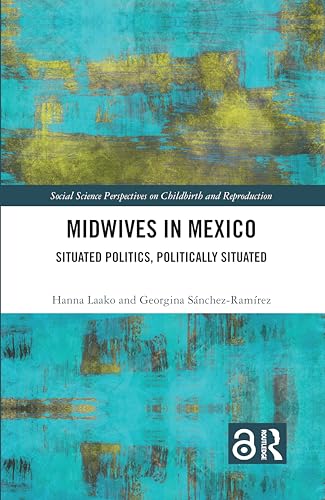
Midwives in Mexico : situated politics, politically situated Hanna Laako and Georgina Sánchez Ramírez
Tipo de material: Libro
impreso(a)
Idioma: Inglés Series Analíticas: Mostrar analíticasDetalles de publicación: London, England, United Kingdom Routledge Taylor & Francis Group 2021Edición: Primera ediciónDescripción: xx, 224 páginas 24 centímetrosTipo de contenido:
Libro
impreso(a)
Idioma: Inglés Series Analíticas: Mostrar analíticasDetalles de publicación: London, England, United Kingdom Routledge Taylor & Francis Group 2021Edición: Primera ediciónDescripción: xx, 224 páginas 24 centímetrosTipo de contenido: - Texto
- Computadora
- Recurso en línea
- 0367473410
- 9780367473419
- EE/618.20972 L3
| Tipo de ítem | Biblioteca actual | Colección | Signatura topográfica | Copia número | Estado | Código de barras | |
|---|---|---|---|---|---|---|---|
| Libros | Biblioteca San Cristóbal Ediciones ECOSUR (EE) | ECOSUR | EE 618.20972 L3 | EJ. 2 | Disponible | ECO010020547 | |
| Libros | Biblioteca San Cristóbal Ediciones ECOSUR (EE) | ECOSUR | EE 618.20972 L3 | Disponible | ECO010020183 |
Incluye bibliografía e índice: páginas 217-224
Notes on contributors.. Foreword by Robbie Davis-Floyd.. Acknowledgments.. List of abbreviations.. Introduction: Navigating the midwifery waters in Mexico.. Situated author: Hanna Laako.. Situated author: Georgina Sánchez-Ramírez.. The structure of the book.. References.. 1 Underdogs, turf wars and revivals: Politically situated Mexican midwiferies in historical, multiscale perspective .. Introduction.. Situated knowledges.. The birth of the modern midwife and her dilemmas in the Western world.. Two meandering paths: Mexican professional and traditional midwifery in historical perspective.. The two meandering paths in contemporary perspective: The emergence of autonomous midwives.. Conclusions: Autonomy in midwifery.. References.. 2 She breaks paradigms and leaves a trail: The contested terrains of midwifery activism.. Introduction: Midwives and contentious politics.. Autonomous midwives and the methodology of this investigation.. On human rights in social movements.. Midwives, social movements and human rights.. The politicization of autonomous midwives in Mexico.. Herstory 1: Autonomous science- and spirit-based midwifery in Chiapas.. Herstory 2: Autonomous rights- and apprentice-based midwifery in Chiapas and Mexico City.. Conclusions: Articulating and unfolding autonomy in midwifery.. References.. 3 From infantilization to body-territoriality: Birth centers in Mexico.. Introduction: Hospital birth in modern Mexico.. From infantilization to empowerment: The “conscious birth” and birth centers.. Birth centers in global perspective.. In labor: Birth centers in Mexico.. Almost clandestine: Birth centers and the methodology of this research.. The visited facilities/homes.. Working the contractions: The birth model of BCs in Mexico.. Giving birth differently: Laboring naturally or consciously?.. Saying no to hospitalized birth.. Being subject to criticism for having chosen a midwife.. The integral support system of the BC model.. Becoming empowered through the process of birth.. Conclusions.. References.. 4 Dejar pasar: The safe interruption of pregnancy by traditional, Indigenous midwives in southern Mexico.. Introduction: Abortion and midwives in Mexico today.. Antecedents.. Methodology and profile of the midwives.. Dejar pasar: Midwives and safe abortion in Chiapas.. How has the language of abortion changed over time?.. Sorority: Toward the sisterhood.. The procedure: How to generate confidence?.. Viene gente de todo tipo: The women who seek midwives.. Without the midwives, who helps?.. Conclusions: Midwives as human capital in rural regions.. References.. 5 Postcolonial midwifery: Midwives, territories and human rights in development.. Introduction.. Human rights in development, women’s rights in childbirth: What about the women in the Global South?.. Righting wrongs: The humanization of birth and obstetric violence.. Herstory 1: Rural autonomous midwifery in Chiapas.. Herstory 2: Autonomous “midwifery in tradition” in Oaxaca.. Toward postcolonial midwifery: Bringing births back home in Indigenous territories.. Conclusions: Midwives, rights and territories.. References.. Conclusions: Situatedness and the making of worlds in midwifery.. Index
Disponible para usuarios de ECOSUR con su clave de acceso
This book presents the contemporary history and dynamics of Mexican midwifery - professional, (post)modern or autonomous, traditional and Indigenous - as profoundly political and embedded in differing societal stratifications. By situated politics, the authors refer to various networks, spaces and territories, which are also constructed by the midwives. By politically situated, the authors refer to various intersections, unsettled relations and contexts in which Mexican midwives are positioned. Examining Mexican midwiferies in depth, the volume sharpens the focus on the worlds in which midwives are profoundly immersed as agents in generating and participating in movements, alliances, health professions, communities, homes, territories and knowledges. The chapters provide a complex panorama of midwives in Mexico with an array of insights into their professional and political autonomy, (post)coloniality, body-territoriality, the challenges of defining midwifery, and above all, into the ways in which contemporary Mexican midwiferies relate to a complex set of human rights. The book will be of interest to a range of scholars from anthropology, sociology, politics, global health, gender studies, development studies, and Latin American studies, as well as to midwives and other professionals involved in childbirth policy and practice. Alemán