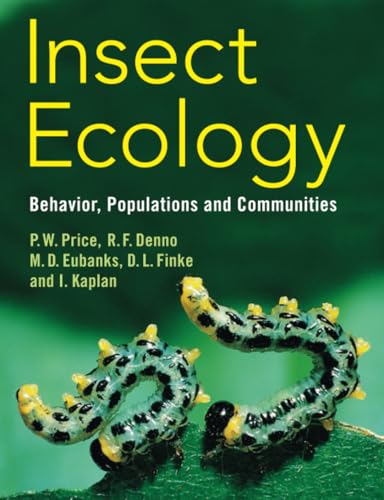
Insect ecology : behavior, populations and communities Peter W. Price, Robert F. Denno, Micky D. Eubanks, Deborah L. Finke, Ian Kaplan
Tipo de material: Libro
impreso(a)
Idioma: Inglés Detalles de publicación: Cambridge Cambridge University Press 2011Descripción: xii, 801 páginas fotografías, ilustraciones, retratos 25 centímetrosISBN:
Libro
impreso(a)
Idioma: Inglés Detalles de publicación: Cambridge Cambridge University Press 2011Descripción: xii, 801 páginas fotografías, ilustraciones, retratos 25 centímetrosISBN: - 052154260X
- 9780521542609
- 595.705 I53
| Tipo de ítem | Biblioteca actual | Colección | Signatura topográfica | Estado | Código de barras | |
|---|---|---|---|---|---|---|
| Libros | Biblioteca Tapachula Acervo General (AG) | Acervo General | 595.705 I53 | Disponible | ECO020012927 |
Incluye bibliografía: páginas 639-763 e índice: páginas 764-801
Glosario: páginas 617-638
Preface.. Acknowledgments.. Part I. Introduction.. 1. The scope of insect ecology.. Part II. Behavioral ecology.. 2. Behavior, mating systems, and sexual selection.. 3. Social insects: the evolution and ecological consequences of sociality.. Part III. Species interactions.. 4. Plant and herbivore interactions.. 5. Lateral interactions: competition, amensalism, and facilitation.. 6. Mutualisms.. 7. Prey and predator interactions.. 8. Host and parasite interactions.. Part IV. Population Ecology.. 9. Demography, population growth and life tables.. 10. Life histories.. 11. Population dynamics.. Part V. Food webs and communities.. 12. Community structure.. 13. Multitrophic interactions.. Part VI. Broad patterns in nature.. 14. Biological diversity.. 15. Planet Earth: patterns and processes.. Glossary.. References.. Author index.. Taxonomic index.. Subject index
Combining breadth of coverage with detail, this logical and cohesive introduction to insect ecology couples concepts with a broad range of examples and practical applications. It explores cutting-edge topics in the field, drawing on and highlighting the links between theory and the latest empirical studies. The sections are structured around a series of key topics, including behavioral ecology; species interactions; population ecology; food webs, communities and ecosystems; and broad patterns in nature. Chapters progress logically from the small scale to the large; from individual species through to species interactions, populations and communities. Application sections at the end of each chapter outline the practicality of ecological concepts and show how ecological information and concepts can be useful in agriculture, horticulture and forestry. Each chapter ends with a summary, providing a brief recap, followed by a set of questions and discussion topics designed to encourage independent and creative thinking. Inglés