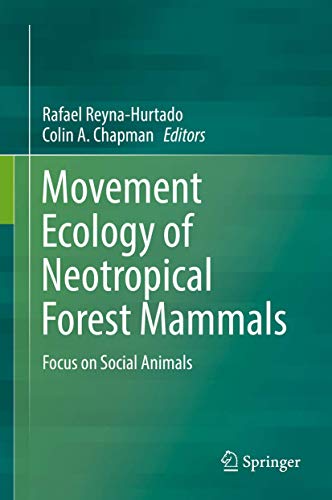
Movement ecology of neotropical forest mammals : focus on social animals Rafael Reyna-Hurtado, Colin A. Chapman, editors
Tipo de material: Libro
impreso(a)
y electrónico
Idioma: Inglés Analíticas: Mostrar analíticasDetalles de publicación: Geneva, Switzerland Springer Nature Switzerland AG 2019Descripción: xii, 274 páginas fotografías, ilustraciones, mapas, retratos 24 centímetrosTipo de contenido:
Libro
impreso(a)
y electrónico
Idioma: Inglés Analíticas: Mostrar analíticasDetalles de publicación: Geneva, Switzerland Springer Nature Switzerland AG 2019Descripción: xii, 274 páginas fotografías, ilustraciones, mapas, retratos 24 centímetrosTipo de contenido: - Texto
- Computadora
- Recurso en línea
- 9783030034627
- EE/599.098 M6
| Tipo de ítem | Biblioteca actual | Colección | Signatura topográfica | Estado | Código de barras | |
|---|---|---|---|---|---|---|
| Libros | Biblioteca Campeche Ediciones ECOSUR (EE) | ECOSUR | EE 599.098 M6 | Disponible | ECO040006971 | |
| Libros | Biblioteca Electrónica Recursos en línea (RE) | ECOSUR | Recurso digital | ECO400155796734 |
Incluye bibliografía e índice: página 269-274
1 Why Movement Ecology Matters.. 2 The Impact of Hurricane Otto on Baird’s Tapir Movement in Nicaragua’s Indio Maíz Biological Reserve.. 3 White-Lipped Peccary Home-Range Size in the Maya Forest of Guatemala and México.. 4 White-Lipped Peccary Movement and Range in Agricultural Lands of Central Brazil.. 5 Movements of White-Lipped Peccary in French Guiana.. 6 Spatial Ecology of a Large and Endangered Tropical Mammal: The White-Lipped Peccary in Darién, Panama.. 7 Movements of Neotropical Forest Deer: What Do We Know?.. 8 Daily Traveled Distances by the White-Tailed Deer in Relation to Seasonality and Reproductive Phenology in a Tropical Lowland of Southeastern Mexico.. 9 Terrestrial Locomotion and Other Adaptive Behaviors in Howler Monkeys (Alouatta pigra) Living in Forest Fragments.. 10 Variation in Space Use and Social Cohesion Within and Between Four Groups of Woolly Monkeys (Lagothrix lagotricha poeppigii) in Relation to Fruit Availability and Mating Opportunities at the Tiputini Biodiversity Station, Ecuador.. 11 Home Range and Daily Traveled Distances of Highland Colombian Woolly Monkeys (Lagothrix lagothricha lugens): Comparing Spatial Data from GPS Collars and Direct Follows.. 12 Ranging Responses to Fruit and Arthropod Availability by a Tufted Capuchin Group (Sapajus apella) in the Colombian Amazon.. 13 Insights of the Movements of the Jaguar in the Tropical Forests of Southern Mexico.. 14 Movements and Home Range of Jaguars (Panthera onca) and Mountain Lions (Puma concolor) in a Tropical Dry Forest of Western Mexico.. 15 Next Moves: The Future of Neotropical Mammal Movement Ecology.. Index
Disponible para usuarios de ECOSUR con su clave de acceso
This book brings a unique perspective to animal movement studies because all cases came from tropical environments where the great diversity, either biological and structurally (trees, shrubs, vines, epiphytes), presents the animal with several options to fulfill its live requirements. These conditions have forced the evolution of unique movement patterns and ecological strategies. Movement is an essential process in the life of all organisms. Animals move because they are hungry, thirsty, to avoid being eaten, or because they want to find mates. Understanding the causes and consequences of animal movement is not an easy task for behavioural ecologists. Many animals are shy, move in secretive ways and are very sensible to human presence, therefore, studying the movements of mammals in tropical environments present logistical and methodological challenges that have recently started to be solved by ecologist around the world. In this book we are compiling a set of extraordinary cases where researchers have used some of the modern technology and the strongest methodological approaches to understand movement patterns in wild tropical mammals. We hope this book will inspire and encourage young researchers to investigate wild mammal´s movements in some of the amazing tropical environments of the world. Inglés
Haga clic en una imagen para verla en el visor de imágenes