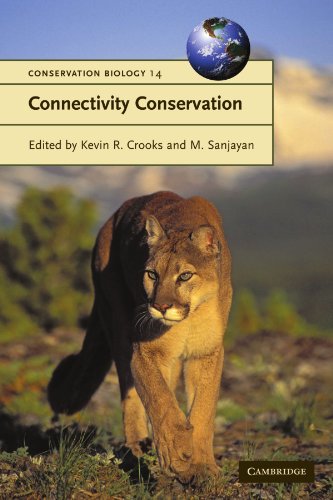
Connectivity conservation editors: Kevin R. Crooks and M. Sanjayan
Tipo de material: Libro
impreso(a)
Idioma: Inglés Series Detalles de publicación: Cambridge Cambridge University Pres 2006Descripción: xvi, 712 páginas ilustraciones, mapas 23 centímetrosISBN:
Libro
impreso(a)
Idioma: Inglés Series Detalles de publicación: Cambridge Cambridge University Pres 2006Descripción: xvi, 712 páginas ilustraciones, mapas 23 centímetrosISBN: - 052167381X
- 9780521673815
- 333.9516 C69
| Tipo de ítem | Biblioteca actual | Colección | Signatura topográfica | Estado | Código de barras | |
|---|---|---|---|---|---|---|
| Libros | Biblioteca Chetumal Acervo General (AG) | Acervo General | 333.9516 C69 | Disponible | ECO030008541 |
Incluye bibliografía e índice: páginas 695-712
List of contributors.. Acknowledgements.. 1. Connectivity conservation: maintaining connections for nature.. Part I. Approaches to Connectivity Research.. Introduction: connectivity - what are the issues.. 2. Landscape connectivity: a return to the basics.. 3. Connectivity and metapopulation dynamics in highly fragmented landscapes.. 4. Genetics and landscape connectivity.. 5. Connectivity at the land-water interface.. 6. Influence of natural landscape fragmentation and resource availability on distribution and connectivity of gray wolves (Canis lupus in the archipelago of coastal British Columbia, Canada.. 7. Migratory connectivity.. 8. Connectivity in marine ecosystems: the importance of larval and spore dispersal.. 9. Connectivity and wide-ranging species in the ocean.. 10. Hydrologic connectivity: a neglected dimension of conservation biology.. 11. Connectivity and ecosystem services: crop pollination in agricultural landscapes.. Part II. Assessing Connectivity.. Introduction: evaluating and quantifying the conservation dividends of connectivity.. 12. Quantifying connectivity: balancing metric performance with data requirements.. 13. Assessing connectivity in salmonid fishes with DNA microsatellite markers.. 14. Individual-based modeling as a tool for conserving connectivity.. 15. Linking connectivity to viability: insights from spatially-explicit population models of large carnivores.. 16. Impacts of corridors on populations and communities.. 17. Exploring the functional connectivity of landscapes using landscape networks.. Part III. Challenges and Implementation of Connectivity Conservation.. Introduction: don't fence me in.. 18. Hyperconnectivity, invasive species, and the breakdown of barriers to dispersal.. 19. Disease and connectivity.. 20. Maintaining and restoring connectivity in landscapes fragmented by roads.. 21. Where to draw the line: integrating feasibility into connectivity planning
22. South coast missing linkages: restoring connectivity to wildlands in the largest metropolitan area in the United States.. 23. Incorporating connectivity into broad-scale conservation planning.. 24. Escaping the minimalist trap: Design and implementation of large-scale biodiversity corridors.. 25. The role of connectivity in Australian conservation.. 26. The future of connectivity conservation.. Index
One of the biggest threats to the survival of many plant and animal species is the destruction or fragmentation of their natural habitats. The conservation of landscape connections, where animals, plants, and ecological processes can move freely from one habitat to another, is therefore an essential part of any new conservation or environmental protection plan. In practice, however, maintaining, creating, and protecting connectivity in our increasingly dissected world is a daunting challenge. This fascinating volume provides a synthesis on the current status and literature of connectivity conservation research and implementation. It shows the challenges involved in applying existing knowledge to real-world examples and highlights areas in need of further study. Containing contributions from leading scientists and practitioners, this topical and thought-provoking volume will be essential reading for graduate students, researchers, and practitioners working in conservation biology and natural resource management. Inglés